Scale Your Income with AI Video Automation via KinoPipe
The New Era of Video Content Creation: Profiting from AI Video Automation
 workflow-automation.
- Social Media Repurposing: Taking long-form YouTube videos and turning them into vertical 9:16 Reels, TikToks, or YouTube Shorts.
- E-commerce Product Optimization: Automatically resizing and compressing product videos to meet the strict file size requirements of Shopify or Amazon.
- Automated Captioning Services: Providing "burned-in" subtitles for creators who want to increase engagement through accessibility.
- Bulk Video Compression: Helping agencies manage massive storage costs by converting 4K raw footage into web-optimized formats.
By specializing in one of these niches, you can list your services on platforms like Fiverr or Upwork. Instead of charging $50 per video for manual editing, you can charge $5 per video and process hundreds of them using an automated pipeline.
The Technical Engine: Moving Beyond the Command Line
Traditionally, video automation required deep knowledge of FFmpeg and complex shell scripts. While FFmpeg is the industry standard for video processing, running it manually or through custom scripts is prone to errors, security risks, and scaling issues. This is where the modern "agentic" workflow changes the game.
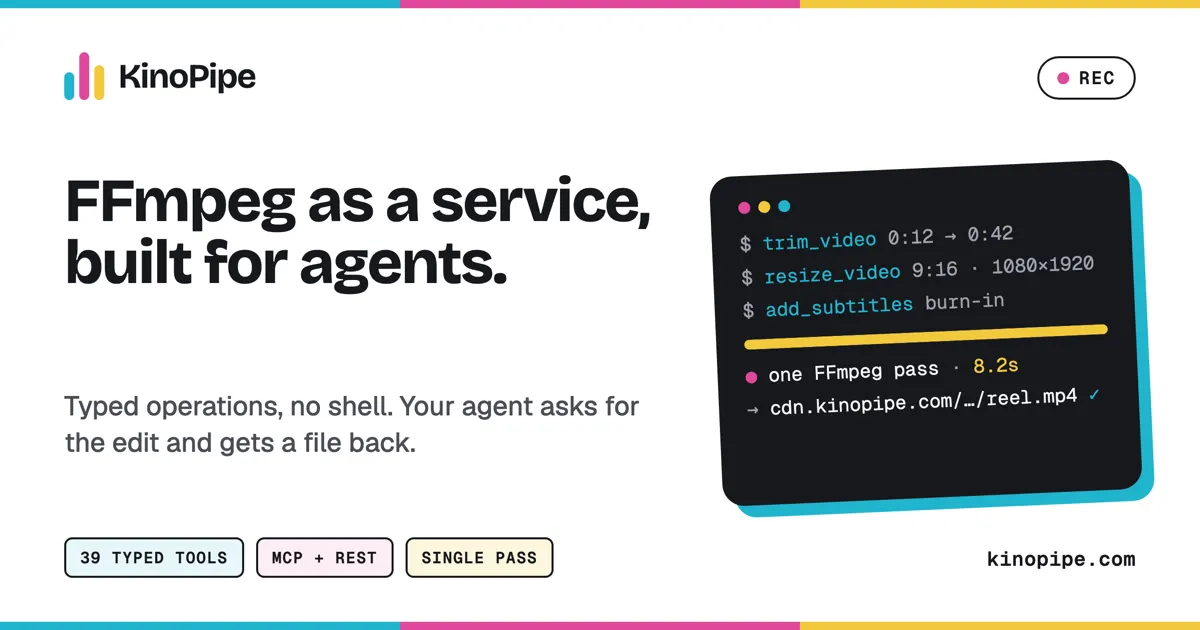
Newer platforms like KinoPipe allow you to interact with video processing engines through "typed tools." This means instead of writing code to handle a video, you use an AI agent to call specific, validated functions. For example, instead of debugging a command-line error, you simply tell an agent: "Resize this video to 9:16 and add subtitles." The agent then calls a specific API endpoint like kinopipe.resize_video, ensuring the request is valid and the output is guaranteed.
This shift from "writing code" to "orchestrating agents" is the foundation of the next generation of SaaS (Software as a Service) businesses. You can build a wrapper service that uses these APIs to provide a simplified interface for non-technical clients.
Building Your Automated Video Agency: A Step-by-Step Guide
If you want to move from a freelancer to a business owner, follow this blueprint to set up an automated production line.
Step 1: Define Your Tech Stack
You do not need to build your own video rendering servers. Your stack should consist of:
- The Brain: An AI model like Claude or ChatGPT to interpret client requests.
- The Orchestrator: A tool like n8n or Zapier to connect your incoming orders to your processing engine.
- The Engine: A specialized video API like KinoPipe that handles the heavy lifting of rendering and encoding.
- The Delivery: A way to notify the client, such as an automated email or a Slack message.
Step 2: Set Up the Workflow
Step 3: Scaling
Once you have perfected the workflow for yourself, you can productize it. Instead of selling your time, you can build a simple web application—a mini SaaS—where users pay a monthly subscription to access your automated pipeline. You are essentially selling "convenience" and "speed."
Profit Margins and Unit Economics
The beauty of using API-based video automation is the predictable cost structure. Unlike hiring an editor, where costs are fixed per hour, API costs are often based on usage (e.g., per second of video rendered or per megabyte of output). This allows for massive scalability.
Consider this hypothetical scenario for a "Social Media Clipping" service:
- Client Price: $300 per month for 60 automated Reels.
- API Cost: Approximately $0.50 per video (using a
- Total Variable Cost: $30.
- Gross Profit: $270 per client.
With just 10 clients, you are generating $2,700 in monthly profit with almost zero manual labor. Your primary job becomes customer acquisition and ensuring the automation logic remains intact.
Risk Management and Reliability
Furthermore, always prioritize security. Using tools that do not require you to manage raw shell commands protects your infrastructure from malicious injections. By using high-level APIs, you are outsourcing the technical complexity and security risks to specialized providers, allowing you to focus entirely on the business side of your venture.
Final Thoughts
The window for being an "early adopter" in AI video automation is closing. As these tools become more integrated into standard workflows, the competition will increase. The winners will be those who move quickly to build specialized, niche-focused services. Whether you choose to sell your services on Upwork or build your own SaaS platform, the key is to leverage video-automation to decouple your income from your time.
To scale your production capacity, you can integrate these automated AI video processing workflows into your existing content creation pipeline.