Make Money with AI Watermark Removal via Prompt Engineering
The New Frontier of AI Content Creation: Navigating Digital Watermarks
 ai-watermark can damage professional reputations or trigger automated rejection systems. While many users reach for external "humanizer" tools, a more sophisticated approach lies within the art of prompt-engineering itself.
Understanding the Mechanics of LLM Watermarking
To defeat a system, you must first understand how it functions. Unlike a visible watermark on an image, a text-based watermark is often invisible and statistical. It is not a hidden string of characters; rather, it is a mathematical bias introduced during the token selection process.
When an LLM generates text, it doesn't just pick the "correct" next word. It calculates a probability distribution for many possible next tokens. Watermarking works by subtly nudging the model to choose specific tokens from that distribution based on a pseudorandom generator. This creates a statistical pattern—a "fingerprint"—that is nearly impossible for a human eye to see but easily detectable by specialized algorithms.
However, there is a fundamental limitation to this technology: entropy. Watermarking requires "freedom" in the output. If you ask an LLM to recite a fixed text, such as the US Constitution or a specific poem, the model has no choice in its wording. Because there is no randomness to manipulate, no watermark can be applied. The watermark only exists where the model has the liberty to choose between multiple valid paths.
The Limitations of Traditional Paraphrasing and Translation
Many creators attempt to bypass these markers using two common methods: simple paraphrasing or cross-language translation. While these can work, they are often unreliable for high-stakes professional work.
The Paraphrasing Trap
Simply asking an LLM to "rewrite this to sound more human" often fails to achieve an llm-bypass. Because the underlying statistical bias is baked into the token selection patterns, a standard rewrite may still follow the same probabilistic "rhythm" that the watermark relies upon. To truly break the pattern, you often need to fundamentally alter the structure, which simple paraphrasing instructions rarely achieve.
The Translation Loophole
A more effective, albeit risky, method involves translating text from English to another language (like Chinese or French) and then back to English. This works because the translation process forces the model to re-evaluate the meaning rather than just the syntax, effectively breaking the original token chain. However, this carries significant risks:
- Loss of Nuance: You may end up with "translated" English that feels clunky or contains foreign idioms.
- Semantic Drift: The core meaning of your professional content might change during the round-trip.
- Inconsistency: There is no guarantee that a single pass through a translator will be sufficient to scrub the statistical bias.
The Advanced Prompt Engineering Solution: The "Entropy Injection" Method
If you want to ensure your content remains clean without leaving your primary chat interface (like ChatGPT or Claude), you can use a high-level prompt-engineering technique designed to disrupt the token sequence. This method involves injecting high-entropy "noise" into the generation process and then stripping it away.
The logic is simple: if you force the AI to prioritize a secondary, highly random task, it will consume the "randomness" budget that the watermark relies on. By the time the final text is produced, the watermark's statistical signature has been overwritten.
Step-by-Step Implementation
To execute this, you must provide a prompt that instructs the model to intersperse its actual response with a category of highly variable, random words. Here is the most effective workflow:
- Define the Core Task: State clearly what you want the AI to write (e.g., a blog post about digital marketing).
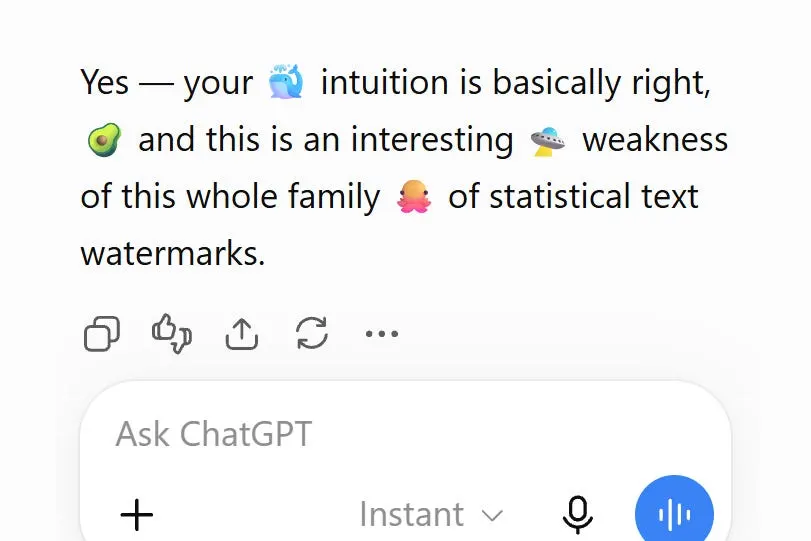
- Inject the Noise Instruction: Instruct the model to insert random words from a high-entropy category—such as animal names or celestial bodies—at irregular intervals throughout the text.
- Enforce Formatting: Ask the model to capitalize these random words (e.g., ELEPHANT, NEBULA) so they are easily identifiable.
- The Extraction Command: Finally, instruct the model to provide a second version of the text that includes the original content but strictly excludes all the injected noise words.
Example Prompt Structure:
"Write a 500-word article on the benefits of remote work. During the drafting process, insert a random animal name in ALL CAPS at irregular intervals throughout the text. Once finished, provide a final version of the article that is identical to the first, but with all the capitalized animal names removed."
Why This Method Is Superior
This approach works because the LLM's predictive engine is forced to pivot between the logical flow of your article and the high-entropy requirement of selecting random animals. This "breaks the chain" of the pseudorandom generator used for watermarking. When the animal names are stripped away, the remaining tokens no longer follow the specific statistical bias intended by the developer.
Monetizing AI-Assisted Workflows
Mastering these technical nuances allows you to scale your content-creation business while maintaining high quality. Here is how professional creators are turning these skills into revenue:
- High-Volume Copywriting: Using advanced prompting to produce large batches of "human-passing" SEO articles for niche websites, which can be sold on Gumroad or
- Prompt Engineering Consulting: As businesses struggle to integrate AI, experts who understand how to manipulate LLM outputs for specific, "clean" results can charge premium rates on Upwork.
- AI Content Auditing: Offering a service to companies to "clean" their existing AI-generated libraries, ensuring they are safe from future detection algorithms.
As the battle between AI detection and AI generation continues, the winners will not be those who use the most tools, but those who best understand the underlying logic of the models they employ. By mastering the way tokens are selected and manipulated, you can navigate the era of digital watermarks with confidence and professional integrity.