Automated AI Video Production Pipeline
How to Build an Automated AI Video Production Pipeline That Sells
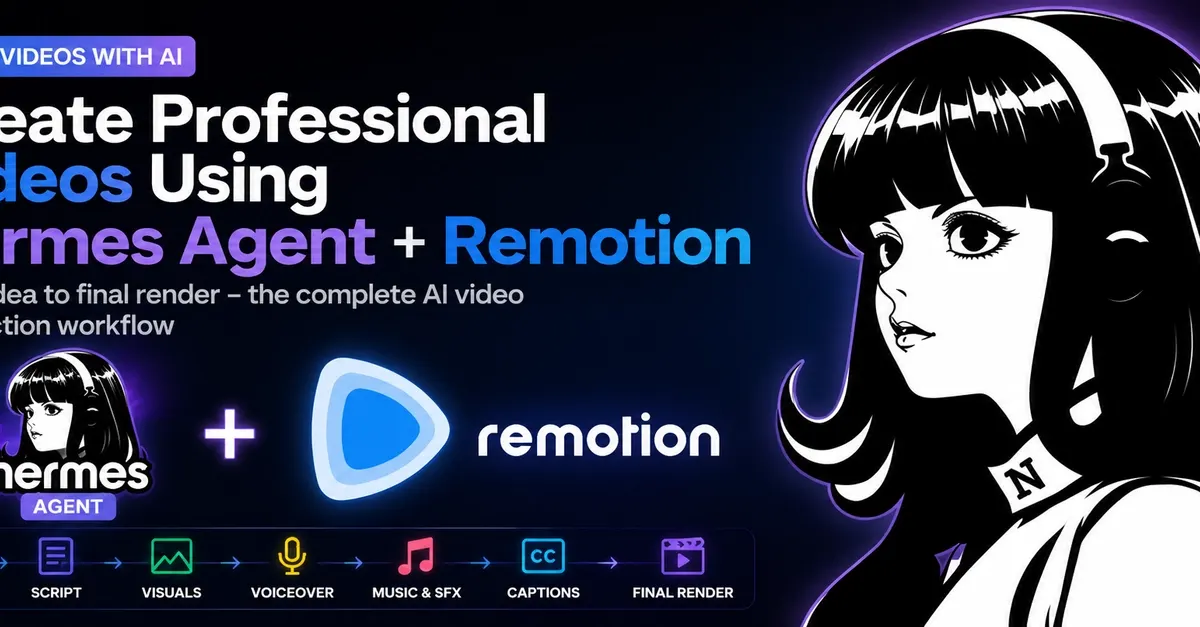
The short-form video market is enormous, and demand for polished, vertical content continues to grow across YouTube Shorts, Instagram Reels, TikTok, and Facebook Reels. Yet producing a single high-quality video still requires juggling research tools, script editors, design platforms, voiceover generators, captioning software, and rendering engines. For solo creators and agencies, this fragmentation eats hours and kills margins.
What if you could describe a video idea in plain language and let an AI Agent handle the entire workflow? That is exactly what an automated AI video production pipeline makes possible. By combining Hermes Agent with Remotion, you can build a repeatable system that researches topics, writes scripts, generates visuals, produces motion graphics, and renders finished videos ready for publishing.
This article walks through how that pipeline works and, more importantly, how you can turn it into a real income stream.
Why Automation Matters for Content Creation
Traditional Content Creation is bottlenecked by manual work. A creator spending two hours on research, three hours on editing, and one hour on revisions per video can realistically produce two to three finished pieces per day. At typical freelance rates on platforms like Upwork or Fiverr, that translates to roughly $100 to $300 per day assuming $50 to $100 per video.
Automation changes the math entirely. When an AI Agent orchestrates research, scripting, asset generation, and even code-level rendering, a single operator can produce 10 to 20 videos per day. At a conservative $30 to $50 per piece sold through platforms like Gumroad or as a service on Fiverr, that is $300 to $1,000 per day with far less repetitive labor.
The key insight is this: automation does not replace creativity. It removes the friction between a creative idea and a finished product, letting you focus on strategy, storytelling, and client relationships.
What Is an Automated AI Video Production Pipeline
An automated pipeline is a sequence of steps coordinated by software, where each stage feeds directly into the next without requiring manual intervention. In the context of AI Video production, this means the system handles:
- Research: Scanning the web for trending topics, evaluating
- Scripting: Writing a narrative script with narration, scene descriptions, and visual cues
- Production Planning: Defining color palettes, animation styles, canvas resolution, frame rate, and editorial direction
- Asset Generation: Creating AI-generated images, graphics, and visual elements
- Motion Graphics: Building animated scenes programmatically
- Voiceover: Generating natural-sounding narration
- Audio Design: Adding background music and sound effects
- Captions: Producing word-level animated captions synced to audio
- Rendering: Exporting a production-ready vertical video file
Instead of switching between ten different applications, you interact with the system in natural language and let it coordinate everything.
Why Hermes Agent and Remotion Are the Right Tools
Remotion takes a different approach to video production. Instead of a traditional timeline editor, Remotion lets you build videos using React components. This means your videos become:
- Version controlled: Every change is tracked in Git, making collaboration and rollback tri
- Reusable: Templates and components can be repurposed across projects
- Programmable: Parameters, data, and logic drive the final output
- Easy to automate: Rendering can be triggered programmatically without a human touching a timeline
When Hermes Agent writes the Remotion code, the result is a fully automated production chain. The agent researches a topic, drafts the script, plans the visuals, generates Remotion components, renders the scenes, and produces a finished video. Automation at this scale is what separates hobbyists from profitable operators.
The Pipeline in Action
From there, the agent converts the research into a complete production script. This script includes narration text, a visual storyboard, Remotion-specific cues, production notes, and detailed scene descriptions. The next step is a production specification document that defines the color palette, animation style, canvas resolution, frame rate, editorial direction, and a full scene breakdown. This document serves as the blueprint for every subsequent step.
With the specification in place, the pipeline automatically generates AI visuals, builds Remotion components for each scene, synthesizes voiceover audio, layers in background music and sound effects, creates animated word-level captions using Whisper timestamps, and finally renders a polished vertical video. The entire process is initiated from a single natural-language instruction.
How to Monetize This Workflow
There are several realistic paths to earning money with an automated AI Video pipeline:
- Freelance video services: Offer video production on Fiverr or Upwork at premium rates. Clients get fast turnaround and high volume, and you charge for efficiency and quality.
- Digital product sales: Package finished videos or video templates on Gumroad or Etsy. Niche content like science explainers, motivational shorts, or educational clips sells well to audiences and other creators.
- YouTube Shorts and TikTok monetization: Build a channel using automated production. Once you have a library of videos, ad revenue and creator fund payouts accumulate passively.
- Agency scaling: Use the pipeline as the engine of a small video agency. Hire or partner with content strategists who handle ideation and client communication while the automated system handles execution.
- Template and tool sales: Build and sell Remotion templates or Hermes Agent workflow bundles to other creators who want to replicate the system.
The most profitable approach usually combines several of these streams. A single workflow can produce content for your own channels, fulfill freelance orders, and generate digital products simultaneously.
Getting Started
You do not need to be a developer to leverage this approach, but familiarity with Remotion's React-based structure helps. Start by setting up a Remotion project and experimenting with simple animated scenes. Then introduce Hermes Agent as your workflow orchestrator, beginning with the research and scripting stages before gradually adding asset generation, voiceover integration, and automated rendering.
The biggest advantage of this pipeline is its scalability. Once the workflow is configured, producing a new video requires minimal additional effort. You can serve multiple clients, launch several content channels, or build a catalog of digital products without proportionally increasing your workload.
Final Thoughts
Automated AI Video production is not a future concept. It is a working reality today, and the creators and agencies who adopt it first will capture the most value. By combining Hermes Agent's orchestration capabilities with Remotion's programmable rendering engine, you build a system that transforms a single idea into a finished, publishable video with minimal manual effort.
The opportunity is clear: faster production, lower costs, higher volume, and multiple revenue streams across platforms like Fiverr, Upwork, Gumroad, YouTube, and TikTok. Whether you are a solo creator looking to scale output or an agency aiming to deliver more with less, an automated pipeline is one of the most practical investments you can make in your Content Creation business today.