Why Performance Max Is a Game-Changer for B2B SaaS Lead Generation
Data Quality Is Non-Negotiable
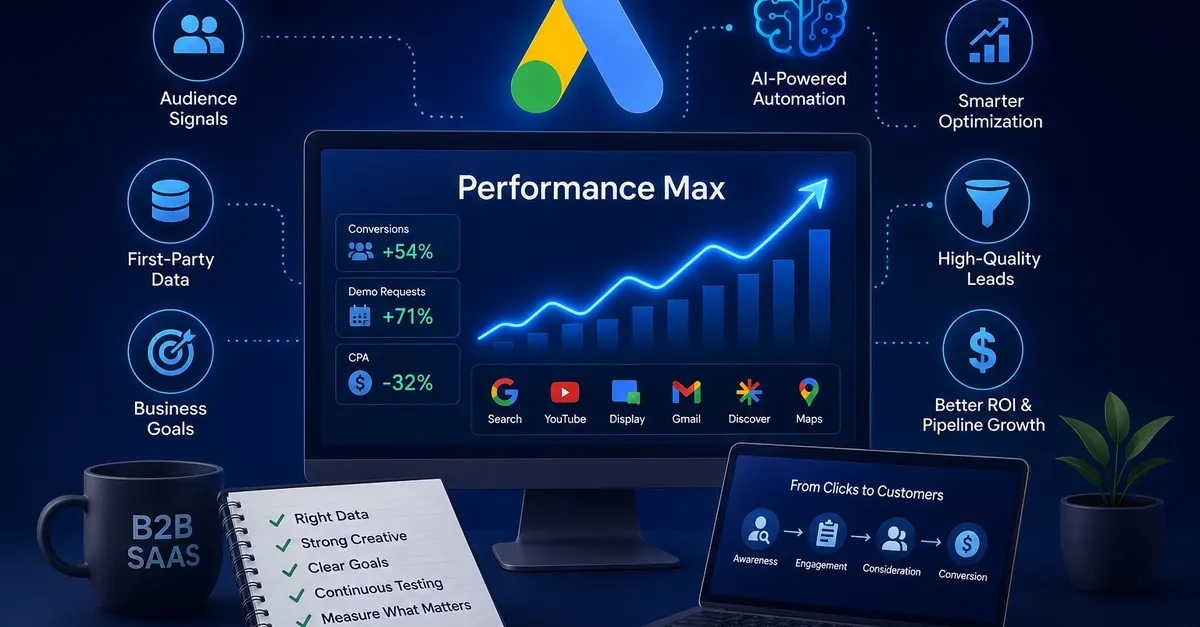
Performance Max relies entirely on the quality and quantity of data you provide. If your conversion tracking is incomplete, your audience signals are vague, or your landing pages underperform, the AI will struggle to deliver results. This is particularly critical for B2B SaaS companies, where the sales cycle is longer and attribution more complex.
To set up Performance Max for success:
- Audit your conversion tracking: Ensure every meaningful action — demo requests, trial signups, content downloads — is tracked and fed back to Google.
- Define clear audience signals: Use your CRM data to build detailed ICPs. Include job titles, company sizes, industries, and past engagement data.
- Optimize landing pages: Your landing page should match the intent of your audience signals and provide a seamless path to conversion.
- Implement proper attribution modeling: Use data-driven attribution or time-decay models to give Google accurate signals about which touchpoints matter most.
Creative Strategy Still Matters
While Performance Max automates placement and bidding, creative quality remains a human responsibility. Generic or poorly produced assets will limit performance, regardless of how sophisticated the AI is.
For B2B SaaS, effective creatives should:
- Address specific pain points relevant to your target personas
- Highlight measurable outcomes, not just features
- Speak to both individual users and buying committees
- Include clear calls-to-action aligned with your conversion goals
Consider running A/B tests on your highest-performing assets to identify patterns that drive engagement. Tools like Canva, Adobe Express, and Descript can help you produce professional-quality creatives at scale.
Measuring Success Beyond Vanity Metrics
One of the most common mistakes B2B SaaS marketers make is measuring Performance Max performance using surface-level metrics like impressions or clicks. While these numbers provide context, they don't tell the full story.
Instead, focus on metrics that reflect true business impact:
- Cost per qualified lead (CPL): Track how much each lead costs and compare it to your acceptable CPL threshold.
- Demo-to-customer conversion rate: Measure how many demo requests from Performance Max eventually become paying customers.
- Customer lifetime value (LTV) by campaign: Understand which audience segments and asset combinations produce the highest-value customers.
- Pipeline contribution: Track how much pipeline revenue can be attributed to Performance Max campaigns.
By connecting Performance Max data to your CRM and attribution platform, you can build a complete picture of how AI-driven advertising contributes to revenue growth.
Scaling Performance Max for Growth
Once you've established a baseline of performance, the next step is scaling. This involves expanding your asset library, refining audience segments, and testing new conversion objectives.
Effective scaling strategies include:
- Adding asset groups: Create separate asset groups for different personas, products, or stages of the buyer journey.
- Expanding audience signals: Test new audience segments based on behavioral data, firmographic data, and lookalike modeling.
- Testing new formats: Experiment with video, responsive search ads, and dynamic assets to keep your campaigns fresh.
- Diversifying conversion actions: Track micro-conversions like page visits, video views, and content engagement to give AI more signals to work with.
Leveraging Gumroad for Content Distribution
Final Thoughts: AI as a Force Multiplier
Performance Max isn't a replacement for strategic marketing — it's an amplifier. For B2B SaaS companies, it provides the reach, efficiency, and data processing power needed to scale lead generation without sacrificing control over messaging and targeting.
The key to success lies in treating Performance Max as part of a larger ecosystem. Combine it with robust Marketing Automation, clean first-party data, and a clear understanding of your target audience. When done right, this approach delivers more qualified leads, lower acquisition costs, and a stronger foundation for sustainable growth.
The future of B2B SaaS advertising isn't about choosing between human strategy and AI execution. It's about combining both to achieve results that neither could deliver alone.