GEO for B2B AI Search Visibility: Build High‑Ticket AI Consulting
The Shift from SEO to GEO: A New Revenue Frontier for B2B Professionals
For two decades, the playbook for digital visibility remained largely static. Businesses invested heavily in keyword research, backlink outreach, and technical audits to climb the traditional search ladder. That ladder has effectively collapsed for high-value B2B transactions. Today, enterprise procurement teams bypass the "ten blue links" entirely. They open ChatGPT, Perplexity, Claude, or Google AI Overviews and ask direct, high-intent questions: "Which contract management platform integrates best with our existing CRM stack?" or "Compare the top three vendors for AI-driven supply chain optimization."
If your brand—or your client's brand—does not appear in that synthesized answer, you do not exist to that buyer. This fundamental restructuring of discovery has created a massive, underserved market: Generative Engine Optimization (GEO). For freelancers, agencies, and consultants, mastering GEO is not just a new service offering; it is a high-ticket revenue stream that solves an urgent, expensive problem for enterprise clients.
Why GEO Commands Premium Rates in the Current Market
Traditional SEO retainers often range from $2,000 to $5,000 monthly for mid-market clients, with uncertain ROI timelines stretching 6 to 12 months. GEO engagements, by contrast, target the AI search layer where purchase decisions are actually finalized. The conversion mechanics are radically different. Data indicates that conversational AI search drives qualified conversion rates between 6.8% and 12.4%, compared to the 1.8% to 3.2% average of traditional organic search. That represents a 285% increase in pipeline velocity.
Core Service Pillars You Can Monetize Immediately
Building a profitable GEO practice requires packaging technical execution into clear, sellable deliverables. Here are the four pillars that drive revenue.
1. Entity Graph Infrastructure & Knowledge Graph Alignment
Large Language Models (LLMs) do not "crawl" the web in real-time the way Googlebot does. They rely on vector embeddings, training weights, and Retrieval-Augmented Generation (RAG) pipelines that pull from trusted knowledge bases (Wikidata, Crunchbase, proprietary indexes). Your first billable deliverable is structuring the client's digital identity so machines understand it unambiguously.
- Schema.org Implementation: Deploying advanced
Organization,Product, andTechArticleschema that maps directly to global knowledge graph IDs. - Entity Disambiguation: Resolving naming collisions (e.g., "Acme Corp" vs. "Acme Analytics") so the model retrieves the correct entity.
- Knowledge Base Submissions: Managing entries on Wikidata, Wikipedia (notability permitting), and industry-specific directories that feed training corpora.
Pricing Model: One-time setup fees of $5,000–$15,000 plus a quarterly "graph maintenance" retainer of $1,500–$3,000.
2. High Information-Gain Asset Creation (The "Citable
- Original Research Reports: Designing and executing industry surveys or technical benchmarks.
- Technical Documentation & White Papers: Structuring deep-dive architecture guides with dense fact tables, schemas, and reproducible methodologies.
- Developer & API Publishing OpenAPI specs and integration guides to platforms like GitHub, Hugging Face, and ReadTheDocs, which are high-priority retrieval targets.
Pricing Model: Project-based fees of $8,000–$25,000 per major asset, often bundled with a 12-month distribution and monitoring contract.
3. RAG Optimization & Corpus Engineering
This is the technical deep end where few generalist SEOs compete. RAG optimization involves influencing the specific documents retrieved by the AI at inference time. You are optimizing for the retriever, not just the ranker.
- Chunking Strategy Audits: Analyzing how client content is segmented by embedding models (e.g., OpenAI text-embedding-3-large, Cohere Embed) and restructuring headers/paragraphs for semantic density.
- Vector Database Seeding: Working with clients who maintain internal RAG systems (or partner platforms) to ensure approved collateral is indexed with high priority.
- Cross-Platform Knowledge Pinning: Syndicating high-signal content to platforms known to be in major training/retrieval corpora (e.g., arXiv, Papers with Code, major technical blogs, Stack Overflow).
Pricing Model: High-touch consulting at $300–$500/hr or monthly retainers of $7,500+ for ongoing corpus management.
4. Automated LLM Share-of-Voice Monitoring
You cannot improve what you do not measure. Traditional rank trackers (Ahrefs, Semrush) are blind to conversational AI. You need to track brand mentions across hundreds of prompt variations daily: "Best alternative to [Competitor] for [Use Case]," "Risks of [Client Category] software," "Implementation timeline for [Client Product]."
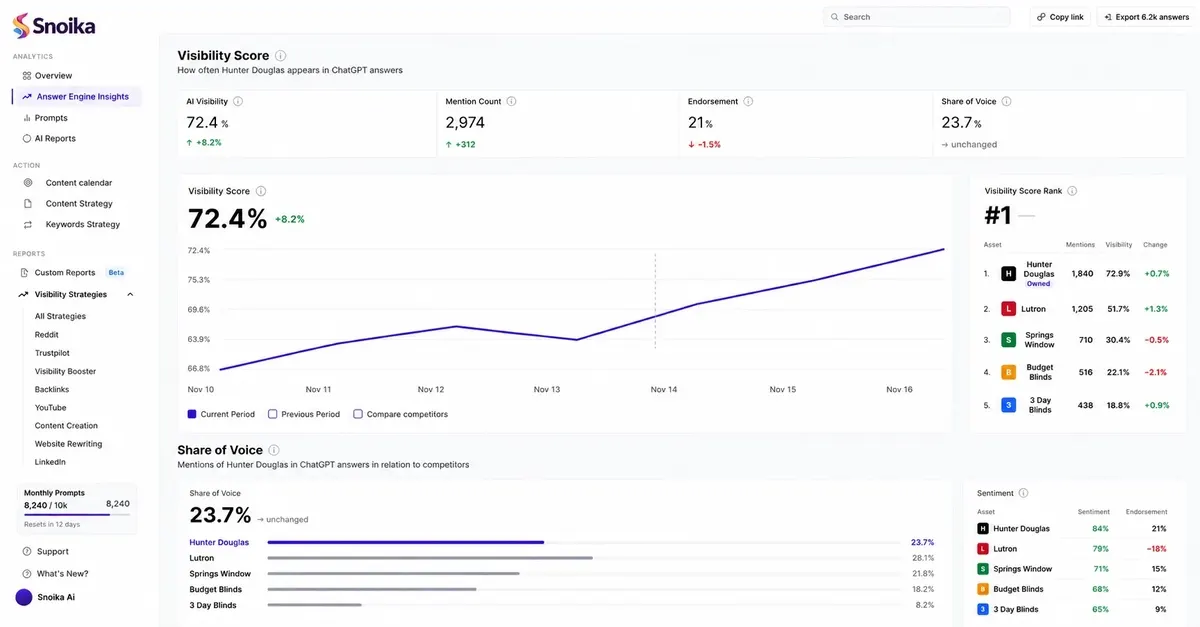
This requires specialized tooling. Platforms like Snoika automate this prompt monitoring at scale, tracking exactly which brands the models surface, the sentiment of the synthesis, and whether citations link back to owned assets. Selling the insight from this data—competitive disambiguation reports, citation gap analyses, hallucination alerts—is a recurring revenue engine.
- Monthly Visibility Reports: Share-of-voice trends vs. top 5 competitors.
- Citation Gap Analysis: "The model cites Competitor X's benchmark for 'latency'; you have no comparable asset."
- Hallucination Defense: Catching fact drift (wrong pricing, deprecated features) before it reaches buyers.
Pricing Model: SaaS-enabled service. Tool access + analyst interpretation: $2,500–$7,500/mo.
Operationalizing the Business: From Freelancer to Specialized Agency
Packaging for Upwork and Direct Sales
On platforms like Upwork or Fiverr Pro, do not list "GEO Expert." Buyers there search for outcomes. Use titles like:
- "AI Search Visibility Audit for B2B SaaS — Get Cited by ChatGPT/Perplexity"
- "Enterprise GEO Strategy: Knowledge Graph + RAG Corpus Optimization"
- "LLM Monitoring Setup: Track Brand Mentions in AI Answers Daily"
Case studies are your currency. If you lack client work, build a "sandbox" project. Pick a niche (e.g., "AP Automation Software"), create a dummy brand site, execute the four pillars above, and document the timeline to first AI citation. Publish this case study on your portfolio, LinkedIn, and Medium.
Building a Productized "Starter Pack"
High-ticket consulting has a long sales cycle. Bridge the gap with a fixed-scope, fixed-price "GEO Foundation Audit" ($2,500–$4,000). Deliverables:
- Current AI Visibility Scorecard (Share-of-Voice across 50 core prompts).
- Knowledge Graph Gap Report (Missing/Incorrect entities).
- Top 3 "Citable Asset" Opportunities with outlines.
- Schema & Technical Implementation Checklist.
This audit naturally upsells into the $10k+/mo implementation retainers. It lowers the client's risk and qualifies their budget.
Leveraging Content Platforms for Inbound Leads
Demonstrate expertise where your buyers—B2B founders, CMOs, VPs of Growth—consume content.
- YouTube: Short technical deep-dives: "How I got [Client] cited in Perplexity for 'Best HRIS' in 14 days." Screen-record the Snoika dashboard, show the prompt, show the citation.
- LinkedIn: Weekly "AI Search Visibility" posts analyzing a public company's GEO failures/wins. Tag the CMO.
- Gumroad / Stan Store: Sell a "GEO Prompt Library for B2B Buyers" ($49) or "Schema Templates for SaaS Entity Graphs" ($149). Low-ticket digital products build an email list of qualified leads for high-ticket services.
Stacking the Tech: Tools That Justify Your Invoice
Clients pay for outcomes, but they trust the process more when it runs on professional infrastructure. Beyond standard SEO suites, your stack should include:
- Snoika: Essential for the automated prompt monitoring, share-of-voice tracking, and competitive disambiguation alerts mentioned earlier. It turns "I think we're visible" into "We appear in 68% of evaluation prompts, up from 12% last quarter."
- Schema Validation Tools: Schema Markup Validator, Rich Results Test, and custom JSON-LD generators for complex
DatasetorSoftwareApplicationtypes. - Vector Similarity Checkers: Local scripts (using
sentence-transformers) to test how your client's content chunks align against simulated query embeddings. - API Access: OpenAI, Anthropic, Perplexity (Sonar), and Google Vertex AI APIs for programmatic prompt testing at scale.
Navigating the "Black Box" Objection
The most common pushback: "LLMs are black boxes; you can't guarantee placement." Reframe this immediately. You don't guarantee placement; you guarantee retrievability and factual accuracy.
Explain the deterministic mechanics: RAG systems retrieve top-k documents based on vector similarity. If your client's benchmark report is the only document containing the specific latency figures for "Workload X on Architecture Y," the retriever must fetch it. The generator must synthesize it. You are engineering the input corpus to make the correct output the path of least resistance for the model. This is engineering, not gambling.
Scaling Beyond Hourly: The Equity & Revenue-Share Path
- Base retainer (covers costs) + % of pipeline attributed to "AI Search" lead
- Warrants/Equity for early-stage portfolio companies where you act as Fractional GEO Lead.
This aligns incentives perfectly. You essentially become a growth partner, not a vendor.
The Window Is Narrow
Currently, most B2B boards are asking, "What is our AI search strategy?" but fewer than 5% have a dedicated budget line or vendor for it. The first movers who package GEO as a rigorous, measurable, technical discipline—backed by monitoring infrastructure like Snoika and fueled by high information-gain assets—will capture the lion's share of this budget reallocation from traditional SEO and paid search.
Start by auditing your own presence. Prompt the major models with your ideal buyer's questions. If you aren't the answer, build the assets until you are. Then sell that exact process to the companies watching the same blank screen.