Increase E-commerce Conversions via Social Proof Automation
Leveraging Social Proof Automation to Scale E-commerce Revenue
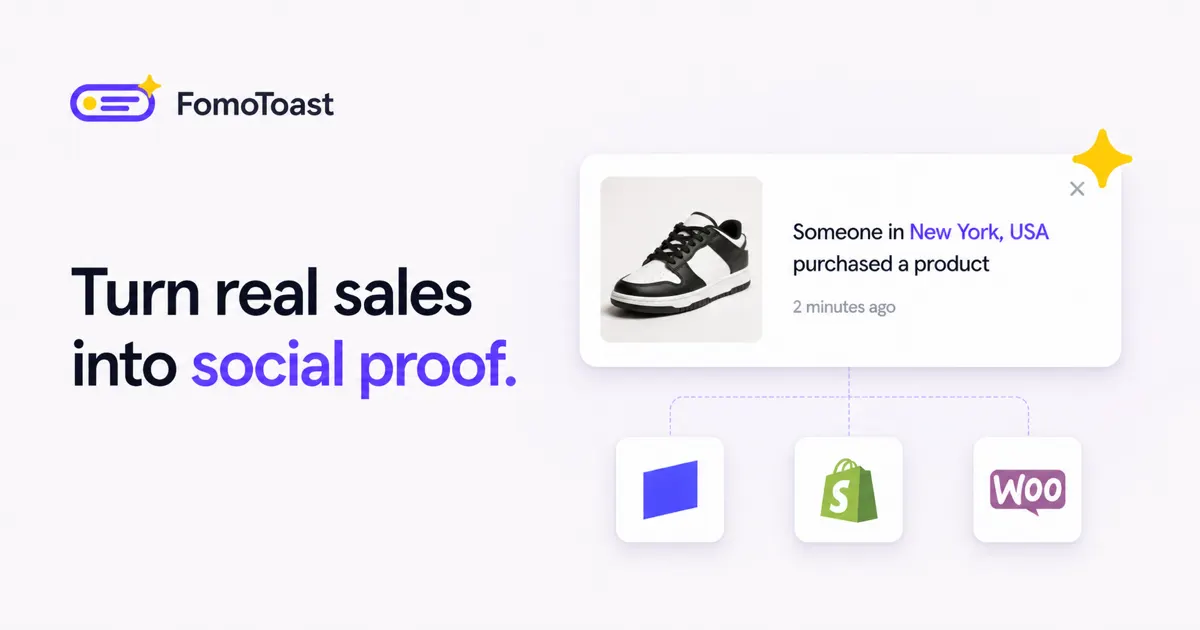
Social proof is a psychological phenomenon where people mirror the actions of others in an attempt to reflect correct behavior in a given situation. In a digital storefront, this manifests as seeing small, non-intrusive notifications that announce a recent purchase or subscription. This strategy works through three distinct psychological levers:
1. Building Instant Credibility
For a new brand or a niche digital creator, the biggest hurdle is being "unproven." When a visitor sees a notification stating that "Noah from Austin just purchased the Studio Kit," the brand is no longer an unknown entity. It becomes a verified participant in the marketplace. This replaces vague claims of "quality" with hard, verifiable evidence of activity.
2. Creating Natural FOMO (Fear of Missing Out)
Most marketers attempt to create urgency through fake countdown timers or "limited stock" warnings that users have learned to distrust. True urgency comes from momentum. When a visitor sees that multiple people have made purchases within the last 30 minutes, they realize the product is currently in demand. This creates a natural sense of urgency that feels earned rather than forced.
3. Reducing Decision Fatigue
The moment of truth usually happens on the pricing, cart, or checkout pages. These are high-friction areas where customers often hesitate. A well-timed notification serves as a "confidence boost," providing a final nudge that reassures the user they are making a safe and popular choice right at the moment of decision.
Implementing Social Proof
The most effective way to deploy these signals is through marketing tech that integrates directly with your existing sales stack. You should not be manually updating your site to show sales; you should be using tools like FomoToast to automate the entire lifecycle.
To maximize conversion rate optimization (CRO), your social proof strategy should follow a three-step integration process:
- Data Integration: Connect your payment processor or e-commerce engine—such as Stripe, WooCommerce, or Shopify—to your social proof tool. This ensures that every notification is a "verified" event, preventing the appearance of fake activity which can damage your reputation.
- Customization and Styling: A notification that looks like a generic pop-up will be ignored or, worse, seen as spam. The "Toast" (the notification bubble) must be styled to match your brand’s typography, colors, and UI. It should feel like an organic part of the user journey, not an interruption.
- Strategic Path Targeting: Not every notification belongs on every page. For example, a "new subscriber" notification is highly effective on a landing page, while a "recent purchase" notification is most powerful on the checkout page to prevent cart abandonment.
Niche Applications: Where to Deploy Automation
Depending on your business model, the way you present social proof will vary. Here is how different sectors can leverage this technology to increase their bottom line:
SaaS Founders and Software Developers
For Software-as-a-Service (SaaS) companies, the goal is to prove recurring value. By connecting Stripe, founders can show real-time subscription updates. Seeing that others are upgrading to "Pro" or "Enterprise" plans provides the necessary context for new users to justify their own subscription costs.
Digital Creators and Educators
If you sell courses, templates, or digital assets on platforms like Gumroad or your own site, your biggest challenge is proving that your intellectual property is worth the price. Displaying recent sales of a specific digital toolkit provides the validation needed to convert hesitant students into paying customers.
Traditional E-commerce Stores
For physical goods retailers using Shopify or WooCommerce, social proof helps bridge the gap between the digital and physical worlds. Highlighting that a specific item (e.g., "Nike Air Max 90") was just purchased helps signal high turnover and popularity, encouraging the visitor to add the item to their cart before it sells out.
Calculating the ROI of Conversion Optimization
When considering the cost of implementing automation tools, it is vital to look at the potential lift in conversion rate optimization. Small improvements in conversion often lead to massive increases in revenue without requiring additional ad spend.
Consider this scenario:
- Current State: An online store receives 10,000 monthly visitors with a 2% conversion rate. Total monthly orders: 200.
- Average Order Value (AOV): $50. Total Revenue: $10,000.
- Post-Automation State: By implementing verified social proof, the conversion rate increases by just 0.5% (to 2.5%). Total monthly orders: 250.
- New Total Revenue: $12,500.
In this example, a minor tweak in the user experience resulted in a $2,500 monthly revenue increase. This demonstrates that investing in automation and social proof is not just a cosmetic upgrade, but a fundamental driver of scalable growth.
Summary of Best Practices
To ensure your social proof efforts drive sales rather than annoyance, adhere to these professional standards:
- Keep it subtle: Use small "Toasts" that do not block the main Call to Action (CTA) or prevent the user from navigating the site.
- Prioritize honesty: Only display verified data from your actual payment gateways. Fake social proof is easily detected by savvy users and can lead to permanent brand damage.
- Focus on relevance: Show product-specific purchases on product pages to keep the context tight and persuasive.
- Leverage automation: Avoid manual updates. Use tools that sync directly with your e-commerce backend to ensure the data is always fresh and real-time.
To further optimize your digital sales funnel, you might also explore these real-world AI monetization case studies for additional inspiration.