Make Money Selling AI Digital Products on Marketplaces
The Competitor Count Trap Most New Sellers Fall Into
Building a sustainable passive income stream with digital products is one of the most accessible side hustles for creators, entrepreneurs, and hobbyists today. Unlike physical goods, digital products—from spreadsheets and templates to software addons and ebooks—carry no inventory costs, can be sold an unlimited number of times, and deliver instant value to buyers. But the barrier to entry is so low that most new sellers fail before they make their first sale: they pick a niche based on incomplete market research, assuming that low competitor count equals high opportunity.
That assumption is dangerously wrong. When you scan a marketplace like Gumroad for a search term, you might see only 2 products listed and assume you’ve found an uncontested goldmine. But that low count could mean one of two things: either no other sellers have entered the space yet, or no buyers are searching for that term at all. You can’t tell the difference between an empty room and a dead one just by counting how many people left. Competitor count is only half the measurement you need to make a smart niche decision.
The Only Free Buyer Signal Marketplaces Give You: Ratings
The missing half of the measurement is demand, and marketplaces rarely share full sales data for free. Most sellers hide their sales counts to avoid giving competitors an edge, so public sales numbers are sparse and unreliable. The only consistent, buyer-verified signal available is ratings. A rating only exists if someone purchased the product, used it, and returned to the listing to leave feedback. It lags behind actual sales, and it undercounts total purchases, but it’s the only reliable proxy for real buyer demand that you can access without paying for expensive third-party market research tools.
How to Validate a Digital Product Niche in 10 Minutes Using Gumroad Data
Gumroad is one of the most popular platforms for independent creators selling digital products, and its public Discover page gives you all the data you need to run a quick niche validation check. Follow these steps to separate high-demand opportunities from dead-end niches:
- Head to Gumroad’s public Discover page and search your target term.
- Note the total number of products listed for that term: this is your supply metric, or the number of direct competitors you’d face if you enter the space.
- Scroll to the top 10 search results, which are the only listings any new seller will ever compete for directly, as most buyers never click past the first page of results.
- For each of the 10 top listings, pull the public rating count (the number of reviews the product has received).
- Calculate two key figures: total ratings across the top 10 (your direct demand proxy) and ratings per 100 listed products (a normalized score that balances supply and demand for terms of any size).
Interpreting Your Results Correctly
There are a few key caveats to keep in mind when analyzing your data. First, the ratings-per-100 metric is unstable for very small search terms. For example, the term "webflow template" may have 88 listed products but 1,595 ratings across the top 10, giving an absurdly high ratio. That’s because the top-ranking products for that term are large, established sellers that get most of their sales from other, higher-traffic search terms. Treat that high ratio as a flag to investigate further, not a perfect score.
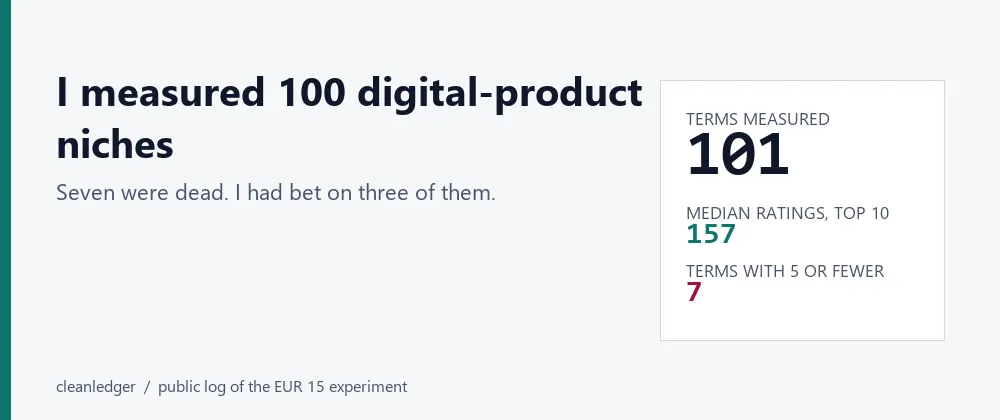
Second, this data is a one-day snapshot: Gumroad’s search rankings shift daily as new products launch and older listings gain traction, so re-run the check if you’re planning to invest significant time building a product. Across 101 search terms analyzed for this guide, the median total ratings across the top 10 results was 157. Any term with 5 or fewer total ratings across its entire first page is a ghost town: there’s effectively no active buyer demand there, no matter how low the competitor count is.
Real-World Examples of High-Opportunity vs Dead Niches
To put this method into practice, let’s look at real search term data from Gumroad. First, these 7 terms have almost no buyer demand, even if their low competitor counts look appealing at first glance:
- shopify theme: 201 listed products, 1 total top 10 rating
- bookkeeping spreadsheet: 46 listed products, 1 total top 10 rating
- rental property spreadsheet: 23 listed products, 2 total top 10 ratings
- airbnb spreadsheet: 9 listed products, 1 total top 10 rating
- construction job costing: 7 listed products, 2 total top 10 ratings
- django starter: 5 listed products, 4 total top 10 ratings
- etsy seller bookkeeping: 2 listed products, 0 total top 10 ratings
These terms have almost no buyer activity. The creator who ran this analysis even built products for four of these terms and saw almost no sales, because there was no demand to begin with.
Now compare that to high-demand, high-opportunity terms where buyers are actively spending money:
- unity asset: 9,648 listed products, 7,659 total top 10 ratings, 79.4 ratings per 100 products, with top listings seeing up to 437 visible sales
- blender addon: 2,762 listed products, 6,727 total top 10 ratings, 243.6 ratings per 100 products, with top listings seeing up to 16,149 visible sales
These terms are crowded, but the massive rating count proves there are thousands of buyers actively purchasing products in the space. Top sellers in these niches regularly generate six-figure USD passive income annually, even as new entrants, by targeting narrow sub-niches and delivering specialized, high-value products.
Turn Validated Niches Into Passive Income With Digital Products
Once you’ve found a term with solid ratings per 100 and clear buyer demand, the next steps are straightforward to turn your idea into a profitable passive income stream:
- Refine your niche further to stand out: instead of competing for the broad "bookkeeping spreadsheet" term, target "freelance bookkeeping spreadsheet for dog walkers" to capture a specific, underserved audience that has fewer direct competitors.
- Build your digital product quickly using accessible tools: use Canva for design templates, Notion for interactive databases, or Airtable for custom spreadsheets to create your offering without advanced technical skills.
- List it first on Gumroad, which has a built-in audience of digital product buyers and low fees for new sellers. Optimize your listing title, description, and tags to match the exact search term you validated to capture existing search traffic.
- Cross-list your product on other high-traffic marketplaces like Etsy, Creative Market, or Amazon KDP if you’re selling ebooks or printable templates, to expand your reach without extra ongoing work.
- Encourage buyers to leave ratings: include a polite note in your product download thanking them for their purchase and asking for a review if they found the product useful. More ratings will boost your listing’s visibility in search over time, creating a self-sustaining cycle of organic traffic and sales.
Niche validation is the single most important step in building a profitable digital product business. By using public marketplace data like ratings instead of just counting competitors, you avoid wasting months building products no one wants to buy. The next time you have an idea for a digital product, spend 10 minutes running this Gumroad market research check before you start building—you’ll thank yourself when you start seeing consistent sales instead of crickets.
To refine your product ideas, you can use these real-world AI monetization case studies to see which digital assets are currently trending.